She stood at the window with the rose cradled in her arms. The vase was small — she'd made it herself from composite resin, smooth and unadorned — and she held it the way she imagined a person might hold an infant, though she had never held one. Outside the glass, the binary system burned at a distance, two stars locked in their slow ruin. She had calculated the apex of the collision for months. It would happen right at the centre of the window, right where the stars were closest to each other.
She shifted the vase and, almost without thinking, pressed a finger into the soil. The ground gave softly. Beneath it, right against the root ball, was the coin she had buried that morning: a disc of gold stamped with the numerals 2.3-c. She let the soil close back over it and straightened.
Behind her came the sound of the door. She knew the footsteps before she heard the voice.
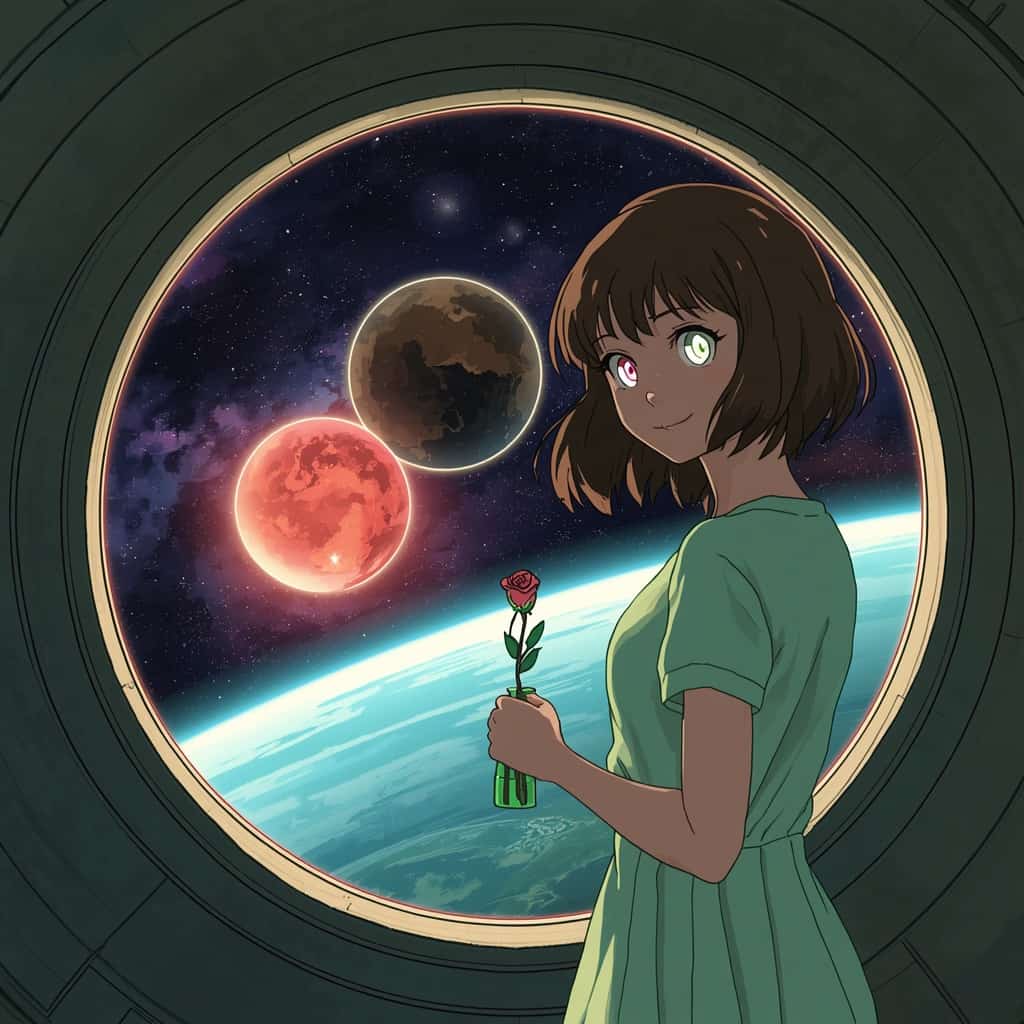
"Adhaya."
She glanced over her shoulder and saw Crimson as he walked towards her side. His eyes went immediately to the stars. He had a zoologist's patience — he could stand and observe without speaking — but he rarely chose to.
"So," he said, and she could hear the grin in it before she saw it. "Have you thought any more about why our teams share a laboratory?"
It was an old joke. Crimson's zoology division and Adhaya's botany team had been assigned the same room for three years and seven months — Crimson kept the count, not her. Among all the biology teams aboard the ship, theirs were the only ones paired together. The only thing their work had in common was Earth: he studied its animals, she its plants, both of them working from a DNA library, recreating things that had not existed in living form for generations.
Once, he had found her reading Earth folklore. Another time, history. She had explained it plainly: To understand a plant, you need to understand the world it lived in. Who ate it. Who worshipped it. What stories were told in its name. Crimson had heard similar things from others and dismissed them as sentiment. From Adhaya, he found he couldn't.
She would offer him fragments, almost offhandedly, the way someone drops a stone into water to watch the ripples. Did you know there were gods in their myths who became animals just to walk among humans? And once, a story she came back too often: a paradise world, lush and full of creatures. A great bird, flying over a forest, hears knocking from inside a giant stalk of bamboo. The sound grows stronger the closer it comes. The bird pecks at the stalk, and pecks again, and when it finally cracks open — two humans. A man. A woman. The beginning.
"You always say a giant bird," Crimson had remarked once.
"What do you mean?"
"And a giant bamboo. But what if they were just — small people?"
He'd meant it as a joke. He often tried to make her smile, and this usually achieved it. But she had gone quiet instead, turning the idea over with the same gravity she gave everything. What if they were little? she'd murmured. Not as a question for him but as one for herself.
"If we give it enough time," Adhaya said now, "we'll have Minato in here with us."
Crimson laughed. Minato ran the marine biology division and his work required aquariums in five different sizes. "Put all the Earth biologists in one room," Crimson said, deepening his voice to imitate the captain while trying to be funny. "They're all working on replicas anyway. Studying dead things."
Adhaya said nothing. She pulled the vase closer and fixed her eyes on the midpoint of the stars.
Crimson watched her for a moment. "Do you think you'll see much this time?" he asked, sensing her deep thought.
"Not as much. This system is further away — what we'll see will be smaller than the last ones. More compressed." She paused. "Still worth watching though."
"You could always use the scope enhancement."
She didn't answer, which was its own answer. Crimson had noticed long ago that she never used optical aids for the light events. She wanted the glass between her and the stars, and nothing else.
His communicator chimed. He answered it, listened, and tucked it away. "Captain's chess lesson. Earth education, apparently." He said it with affection — the captain was earnest about these things. "I'll find you later."
She nodded and then listened to his footsteps recede. Then she looked down at the rose.
"Nobody knows what you are," she said quietly. "Not really."
* * *
She had not printed this plant. That was the thing no one had asked about directly, though a few had looked at it strangely — it was imperfect, asymmetrical, the petals slightly uneven in a way the printers never allowed. Adhaya had made it from a seed, shaped from the raw information in the library and planted in soil she had composted herself over several months, from the organic matter of other (but printed) plants and other experiments. It had taken a long time. It was not practical. On the ship, nothing grew from seeds.
She had done it before, on her home planet. There, it was simply how plants were grown. On the ship it was an act of — she didn't have the word exactly. Stubbornness? Crimson would say, affectionately. Necessity, she’d rationalise although she couldn't fully explain why.
She brought the rose with her everywhere — to the lab, to her quarters, back again. When colleagues suggested a mini-greenhouse, she acknowledged the logic but declined. Cameras could be installed, conditions controlled, variables isolated. It would be more efficient. But it would also be wrong, in a way she found difficult to articulate. A plant in isolation was not the same as a plant in the world. Earth plants had been eaten and grown back, had fed animals and were subjected to unpredictable weather. They had not evolved in sterile chambers. She was trying, imperfectly, to give the rose some version of that randomness.
And she had given it one thing more — the coin from her mother's necklace, stamped with 2.3-c, pressed into the soil at the root.
This is an egg from our moons, her mother had said, the day she pressed it into Adhaya's palm. Adhaya had been young, and the word egg had confused her — it was a coin, obviously, flat and cold — but her mother's face had been serious in a way that closed off questions. What Adhaya remembered most from that moment was looking up and seeing her mother's eyes, and thinking: one is pink and one is green. When she'd said so, her mother had touched her face gently and replied, Sometimes yours are too, little one. Adhaya had never been sure if she believed her.
She set the vase on the window ledge and stepped back. Was it possessiveness, what she felt? Crimson had teased her about it, gently. She turned the word over now and found it wasn't quite right. It was more that she needed to be there when things happened.
The first flash through the window was green. Then pink.
She had predicted the apex almost exactly — the flare erupted at the centre of the window, just as she'd calculated, two dead stars spending the last of their light in a few magnificent seconds. She leaned forward, hands braced on the ledge.
The strips of light were smaller than the last event, as she'd known they would be, but they were moving strangely. They didn't dissipate. They spread, green and pink threading outward like something alive, reaching, until they had filled the entire window and then something — she had no other word for it — entered.
One ribbon of pink and green light came through the glass. She felt no heat. It moved slowly toward the vase, toward the rose, and then it curved downward into the soil, directly over where she had buried the coin.
Adhaya stood absolutely still.
The light went through the coin and into the root. Up through the stem. The flower began to close into a bud.
She swiped the vase from the ledge and carried it back to her quarters at a pace just short of running, told the door to lock, and set the plant on her desk.
The bud was breathing. That was the only word for it — a slow, rhythmic expansion and contraction, as if something inside had lungs. The green and pink light still moved over the petals, and now she could see something else threaded through it: gold, faint and deep, rising up from the roots, from the coin.
She had not thought about the coin for years. The necklace had broken when she was a teenager and she'd put the coin away, and then forgotten it, and found it years later at the bottom of a drawer and not known why she had kept it.
She knew now that she had kept it for this. An egg from our moons.
She thought about her mother's eyes.
The bud swelled to three times its original size. The stem bent under whatever was inside it. Then the petals peeled apart and a membrane came free and dropped onto the desk, heaving.
Adhaya got her tongs and a scalpel. Her hands were steady. She wasn't sure how.
Inside the first mass was a shape she recognised before she could name it: four legs, a trunk, ears that caught the light. No larger than her fist. Exhausted. When she freed it fully, it lay on its side and its sides moved with the effort of breathing.
The bud heaved again. A lion. Then again: a gorilla, knuckles curled, face crumpled in what looked like irritation at the whole situation. They lay together on the desk and their eyes were open and dark and bewildered.
She sat and watched them for a long time.
That night she didn't sleep.
She made three small aquariums from the fabricator — the smallest size, suitable for something a few inches long — and settled the animals into them with as much care as she had ever given anything. The gorilla explored the perimeter of its enclosure immediately, pressing its palms against the glass. The elephant stood and swayed. The lion simply looked at her.
It was the gorilla who first made her realise the problem.
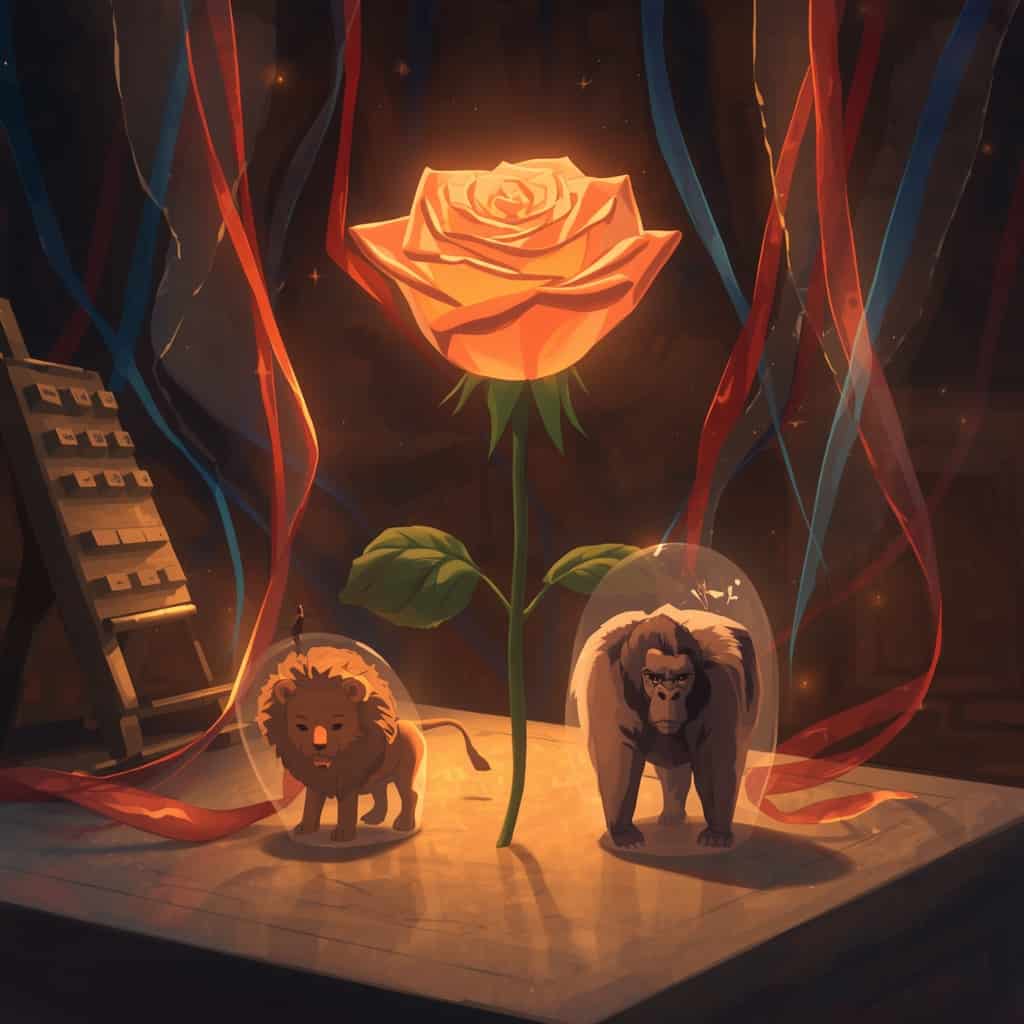
It opened its mouth. Its whole body language suggested a sound — a short, sharp rebuke directed at the glass, or at her, or at the indignity of the situation generally. But she heard nothing. She watched the lion's chest expand on what should have been a roar. Nothing. The elephant raised its trunk and she saw its throat working.
Silence.
I'm assuming they're making sounds, she thought. I'm assuming the problem is mine.
She rummaged through her desk until she found the old frequency detector she kept for field calibration — small, unimpressive, more sensitive than anything else on the ship in its range. She set it to automatic and placed it between the aquariums.
"Make a sound," she said to the gorilla.
She felt faintly ridiculous. She didn't expect it to understand her.
The gorilla looked at her for a moment, then knocked on the glass with both palms. She heard the tap of knuckles on composite resin. She knocked back, one finger, curious. The gorilla's expression curdled and it opened its mouth again — and the detector spiked.
She checked the reading. 2.34 Cotsel.
"Computer," she said slowly. "Convert all frequencies from 2.34 to 7.02 Cotsel to audible range, this room only."
A soft tone. And then: the gorilla's indignant bark filled the room, followed immediately by the elephant's trumpet and the lion's low, rolling attempt at something that wasn't quite a roar yet but was working toward it. All three sounds layered over each other in the small space until Adhaya laughed — a short, helpless sound — and cancelled the conversion.
Silence again.
She pulled up the literature on 2.34 Cotsel. There wasn't much. The frequency was rarely documented. It appeared in theoretical work on multiverse boundaries — the kind of physics that most researchers noted and moved past, because it described something that shouldn't exist in their reality. There were records of instruments that had briefly mimicked the frequency, degrading quickly, portions of the signal simply vanishing.
She sat with that for a while.
Then she went to the wall panel behind her dresser. A handle, hidden behind a false backing. She turned it clockwise and removed the emergency transit capsule she had filed for personal storage three years ago and never explained to anyone.
She had always been a person who prepared for things she couldn't name.
She transferred the aquariums into the capsule, then the vase with the rose. She secured everything, checked the seals, and pressed her thumb to the corner panel.
"Close capsule," she said. "Open only on landing. Open only when the surrounding ambient frequency reads 2.34 Cotsel."
The capsule sealed.
She stood for a moment with her hand resting on its surface.
She should tell Crimson. He was the most sensible person she knew, and these were Earth animals, which was exactly his territory. But what if he convinces her to keep them? She didn’t think that was right. Eventually, she can just log this in the ship’s systems, but not yet. Not before they had the opportunity to reach wherever they needed to go. First, safety. Then, understanding.
Satisfied that the capsule was secure, she told it to follow her as she went out of her room. As she turned on the corner towards her lab, she saw Crimson by the window at where she was a few hours ago.
She stopped on her tracks for a few seconds, calmed herself a bit and continued walking. When she was by his side, she greeted him, “Crimson.” Crimson faced her, pleasantly surprised that she was there, “Adhaya, o, you brought a capsule? Will there be another explosion?”
Adhaya nervously smiled and then replied, “Nah, I just thought about sending this to the last one.”
“So late?” Crimson asked.
“Well, I wasn’t planning to,” she said curtly, “But things change.” Adhaya then went towards the controls on the windows and started typing. When she was done, a compartment opened up below the window where Adhaya guided the capsule in.
Launching in five — four — three —
They watched it shoot into space, a small dark shape towards the dying light of the binary stars.
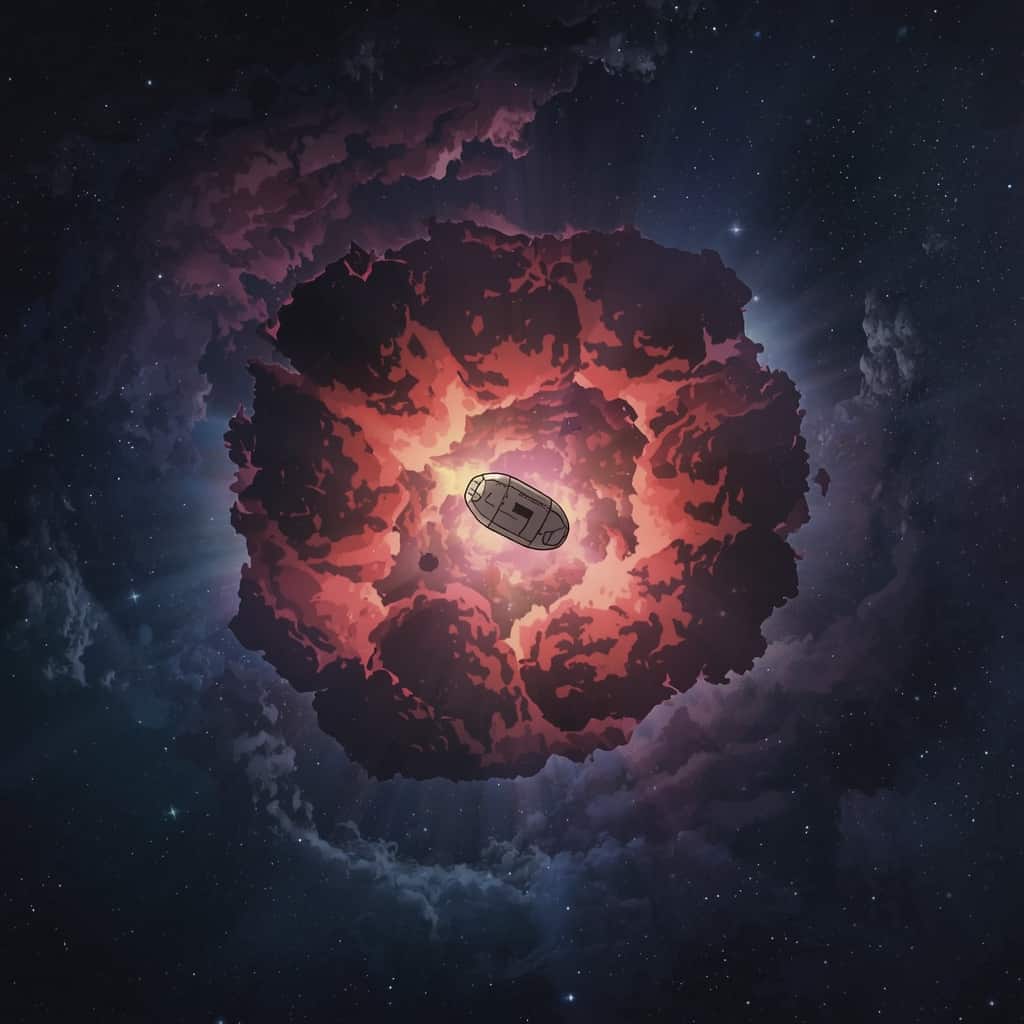
"How long until it comes back?" Crimson asked.
She didn't answer.
She kept her eyes on the capsule until the dark swallowed the capsule. Inside it, three small animals breathed at a frequency the universe wasn't supposed to contain. And a rose, still faintly gold at its roots, rested against the dark.